

Ordo Praedicatorum Provincia Philippinarum
Life of the Friars - under construction


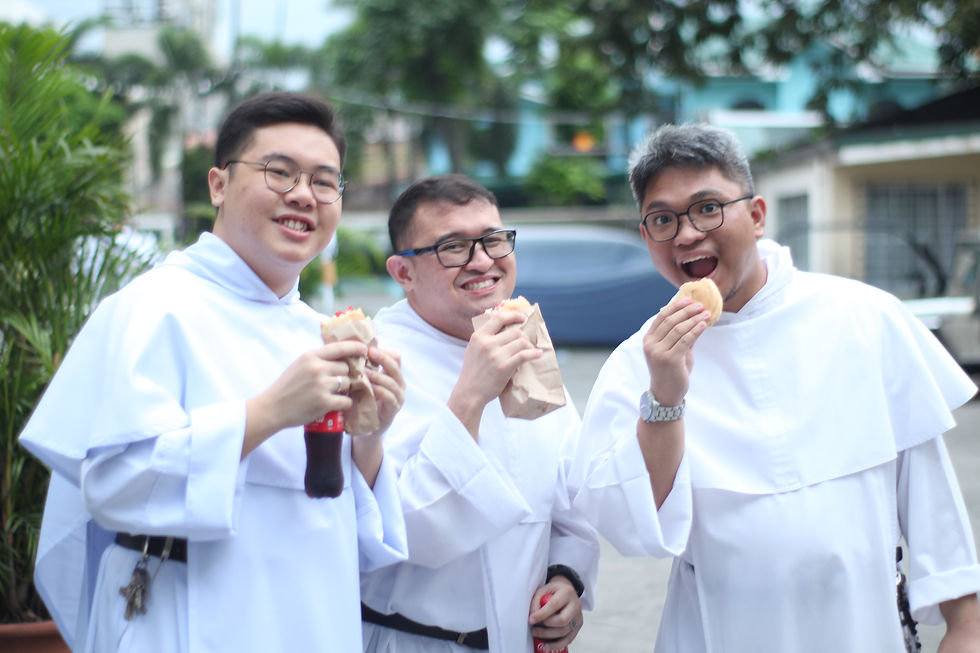


Common Life
LIFE OF THE FRIARS


Study
LIFE OF THE FRIARS

Devotion to the Blessed Virgin Mary
LIFE OF THE FRIARS


From the very beginnings of the Order of Preachers, devotion to the Blessed Virgin Mary has held a central place in Dominican life and mission. This deep love for Mary finds its roots in a profound moment of grace experienced by our holy father St. Dominic.
According to De Dignitate Psalterii by Blessed Alan de la Roche, when St. Dominic saw that his efforts to convert the Albigensians were bearing little fruit due to the weight of their sins, he withdrew into a forest near Toulouse for three days and nights. There, he fasted, wept, and performed severe penances to seek God’s mercy. Exhausted, he fell into a coma.
It was then that the Blessed Virgin Mary appeared to him, accompanied by three angels. She revealed to him the heavenly weapon most effective in spiritual battle—the Angelic Psalter, now known as the Holy Rosary. She told him:
“If you want to reach these hardened souls and win them over to God, preach my Psalter.”
Strengthened by this vision, St. Dominic went forth and preached the Rosary with great zeal. From that moment on, the Rosary became a powerful tool of conversion and a cornerstone of Dominican spirituality.
St. Dominic tenderly fostered Marian devotion and left it as a precious legacy to his spiritual sons... beginning with St. Dominic himself, disseminating the Rosary—a true school of faith and piety.”
Pope Benedict XVI, General Audience, Feb. 3, 2010

In the Philippines, where Filipino’s love for Mary has earned them the name “Pueblo amante de Maria” or “the People in love with Mary”, the devotion to Mother Mary helped the Order in its preaching mission. The Order is blessed to have promoted the devotion to the Our Lady of the Rosary. Today, this devotion continues to flourish in the Dominican Province of the Philippines, where Nuestra Señora del Santísimo Rosario de La Naval de Manila and Nuestra Señora del Rosario de Manaoag are especially honored in two of the country’s most beloved Marian shrines.
One of these devotions is the devotion to Our Lady of the Rosary of La Naval de Manila. The miraculous image of La Naval was created in the earlier half of the 17th century by a heathen Chinese, who eventually was converted to the faith. After its creation, a Spanish governor-general gifted the image to the Dominicans. But what made the sacred image famous were the miraculous victories of the Filipino-Spanish forces against the invading Dutch armada. Formerly housed in the Santo Domingo Church in Intramus before it was bomb during the World War II. After the war, the image is moved to Santo Domingo Church, Quezon City. The feast of La Naval has been celebrated with much pomp and pageantry. National Artist for Literature Nick Joaquin called it “the biggest Marian celebration in Intramuros” and until now, during the Second Sunday of October, many devotees flock together to celebrate the Grand Feast of Our Lady of La Naval.
The Philippine government, through the National Museum, declared the Santo Domingo Church, with its Shrine of Our Lady of the Rosary - La Naval de Manila as a National Cultural Treasure. The declaration, according to the National Museum, recognizes Santo Domingo - La Naval both as an institution and a structure, as well as a repository of modern art. The image of La Naval, which is now housed at the historic Santo Domingo Church in Quezon City, is one of the reasons why the edifice and its liturgical items have been declared by the Philippine Government a National Cultural Treasure, the highest classification conferred by the government on a historical landmark.

The Dominicans in the Philippines is also blessed to foster Marian devotion to the Northern part of the Philippines. There thousands of Pilgrims flock seeking healing for body and spirit, peace and comfort from their problems and struggles through the intercession of the Our Lady of the Rosary of Manaoag or as the locals would call her, Apo Baket, an Iloko word of endearment used to address Our Lady to mean “venerable elder lady”. The devotion to Our Lady of Manaoag started when a farmer heard a call from a beautiful lady that appeared on top of a tree and revealed that she wishes that a church be built on her chosen location. From the term “Man-aoag” that means, both in Pangasinan and Ilocano language, “to call” the word “Manaoag”, was derived and later became also the name of the town. There, not only does Apo Baket guide and bless the locals and pilgrims but she also serves as the Mother of our Dominican Novices. The Shrine was recently elevated to Minor Basilica of Our Lady of Manaoag and is the first church in the Philippines to be given the title of “affiliate” of one of the four papal basilicas, the Basilica of Santa Maria Maggiore. This means that the spiritual benefits that you can gain by visiting the papal basilicas, you can also receive by visiting the Minor Basilica of Our Lady of Manaoag. Tagged as the “Pilgrim Center of the North”, thousands of pilgrims join the Feast of the Our Lady of Manaoag every Third Wednesday of Easter and every 1st Sunday of October. Pilgrims also join the monthly Dawn Procession held every First Saturday of the Month at 4:00 in the morning.


These sacred places continue to welcome countless pilgrims and devotees who come to honor the Blessed Virgin Mary, entrusting their prayers and lives to her maternal care
Presently, the Dominicans in the Philippines has these two miraculous images under their care. Other Marian devotions that the Dominicans handled before were of the Our Lady of Piat in Cagayan and the Virgen Milagrosa del Rosario del Pueblo de Orani.